 listicle
Crescendo.ai Alternatives for Agencies: 2026 Comparison
Table of Contents
- Why Agencies Need Crescendo.ai Alternatives
- AI Customer Support Platforms for Agencies: What to Evaluate
- Top Crescendo.ai Alternatives Compared
- AI Customer Service Software for Multiple Brands: Multi-Client Capabilities
- Crescendo.ai Pricing and Cost Comparison
- Agency-Specific Workflows: White-Labeling and Integration Requirements
- How to Switch From Crescendo.ai to an Alternative
- Frequently Asked Questions
Last Updated: October 19, 2026
Why Agencies Need Crescendo.ai Alternatives
When evaluating crescendo.ai alternatives agencies should consider how service providers scale operations and manage multiple client accounts. The challenge isn't finding an AI customer support solution, it's finding one that handles agencies' unique demands: white-labeling, multi-client management, transparent pricing, and seamless integration with existing workflows.
Many agencies exploring crescendo.ai alternatives agencies discover they outgrow the platform when serving more clients without proportionally increasing support burden. The platform works for single-company implementations, but agencies managing dozens of support operations across brands need different capabilities.
The friction point emerges at scale. A solution optimized for one business doesn't translate to managing support for 10, 20, or 50 clients. You need white-labeling, separate billing, client-specific customization, and the ability to handle vastly different support volumes without renegotiating your contract structure.
AI Customer Support Platforms for Agencies: What to Evaluate
When evaluating AI customer service software for multiple brands, focus on agency-specific capabilities. Generic frameworks miss the factors that determine whether a platform improves your profitability and client satisfaction.
Start with multi-tenancy. Can you create separate instances per client with independent branding, data isolation, and billing?
Next, examine the pricing model. Per-agent pricing works well for a single company but becomes expensive when you're managing support for multiple clients with varying volumes.
Integration capabilities matter tremendously. Clients likely use different CRM systems, ticketing platforms, and communication channels.
Finally, evaluate learning curve and implementation timeline. You need clients live quickly. Platforms requiring weeks of configuration or specialized technical resources slow sales cycles and increase delivery costs.
| Evaluation Criteria | What to Look For | Why It Matters for Agencies |
|---|---|---|
| Multi-tenancy | Separate instances, independent branding per client | Prevents data mixing and maintains client separation |
| Pricing Model | Per-outcome, per-resolution, or usage-based | Scales affordably as client roster grows |
| Integration | CRM, ticketing, communication channel support | Reduces custom development and implementation time |
| Implementation Speed | Days to weeks, not months | Enables faster client onboarding and revenue recognition |
| White-labeling | Full brand customization for client-facing features | Maintains your agency's brand authority with clients |
Top Crescendo.ai Alternatives Compared
Intercom Fin: Outcome-Based AI Resolution
Intercom Fin uses a different pricing model: $0.99 per end-to-end AI-resolved outcome (intercom.com). This appeals to agencies because it ties costs to performance. You're not paying for idle capacity or unused features, only actual customer service resolution.
Outcome-based pricing makes Fin attractive for clients with unpredictable support volumes. A seasonal business saves money in quiet months versus per-agent subscriptions, while a high-volume client benefits from Fin resolving straightforward inquiries without human intervention.
Fin integrates with existing Intercom deployments, which matters if clients already use Intercom.
The primary limitation is that Fin works within the Intercom ecosystem. If your clients use Zendesk, Freshdesk, or other ticketing systems, Fin doesn't directly integrate. You'd need to evaluate whether the outcome-based pricing advantage outweighs the integration friction.
Zendesk for Customer Service: Per-Agent Flexibility
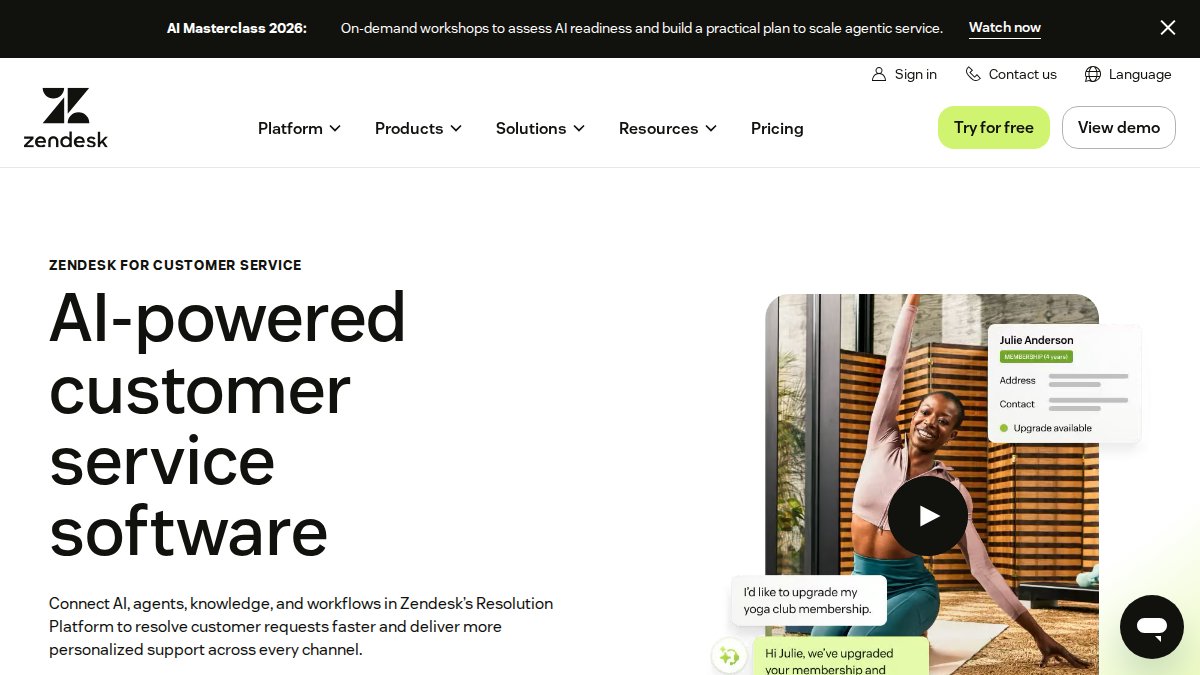
Zendesk uses per-agent pricing starting at $55 per agent per month (billed annually) (Zendesk Pricing Plans). This traditional subscription model provides predictability based on headcount, valuable for agencies managing clients with stable support team sizes.
The platform includes AI capabilities through Zendesk's automation and bot builder features. You can configure AI-powered responses, routing, and ticket classification without separate AI tools, reducing complexity versus bolting on a third-party solution.
Zendesk's strength lies in its extensive integration ecosystem. Your clients likely already use Zendesk or can integrate it with their existing tools.
However, per-agent pricing challenges agencies with fluctuating support needs. Seasonal volume spikes mean paying for unused agents during slow months or scrambling to add capacity during peaks.
Talkdesk: Enterprise-Grade Customer Service
Talkdesk positions itself as an enterprise-grade customer service platform and appears in both G2 and Gartner's Crescendo.ai alternatives lists.
For agencies managing enterprise clients or complex support operations, Talkdesk's feature depth and reliability matter. It supports voice, chat, email, and social media through a unified interface, with workforce management tools to schedule agents across clients.
The tradeoff is complexity. Talkdesk requires more configuration and technical expertise than simpler platforms, and implementation takes longer, increasing delivery costs and delaying revenue recognition. For smaller agencies or straightforward support needs, this is overkill.
Pricing requires direct contact with Talkdesk's sales team, which typically means higher costs than transparent, published pricing. You'll need to negotiate per-client pricing, which adds sales cycle friction when you're trying to scale your agency.
Software-Only Alternatives: Twig, Sierra AI, Decagon, Maven AGI
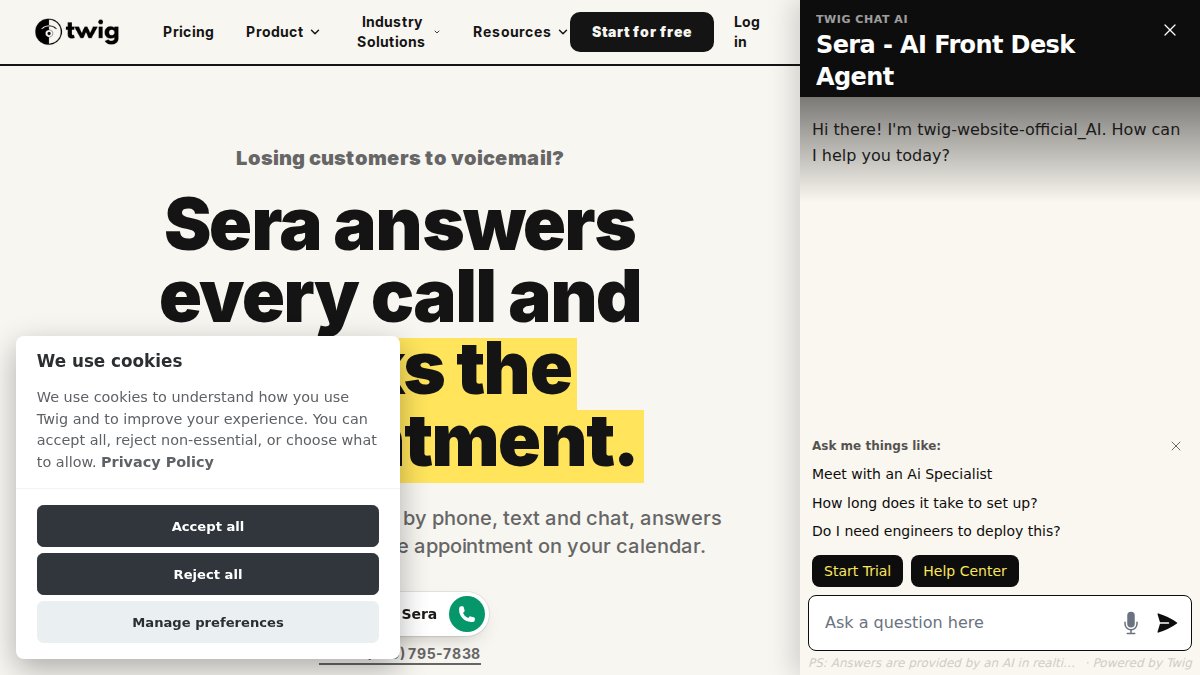
Twig, Sierra AI, Decagon, and Maven AGI are software-only AI support tools, distinct from bundled BPO services.
This approach appeals to agencies that want control over support operations while adding AI.
The limitation is that none of these platforms publish pricing information. You'll need to contact each vendor directly for quotes, which slows your evaluation process and makes it harder to compare costs when pitching solutions to clients.
Software-only alternatives work best when you already have support infrastructure to enhance with AI. If you're building support operations from scratch, a bundled solution like Talkdesk or Zendesk might be more efficient despite higher costs.
Salesforce Agentforce and PolyAI: Enterprise Options
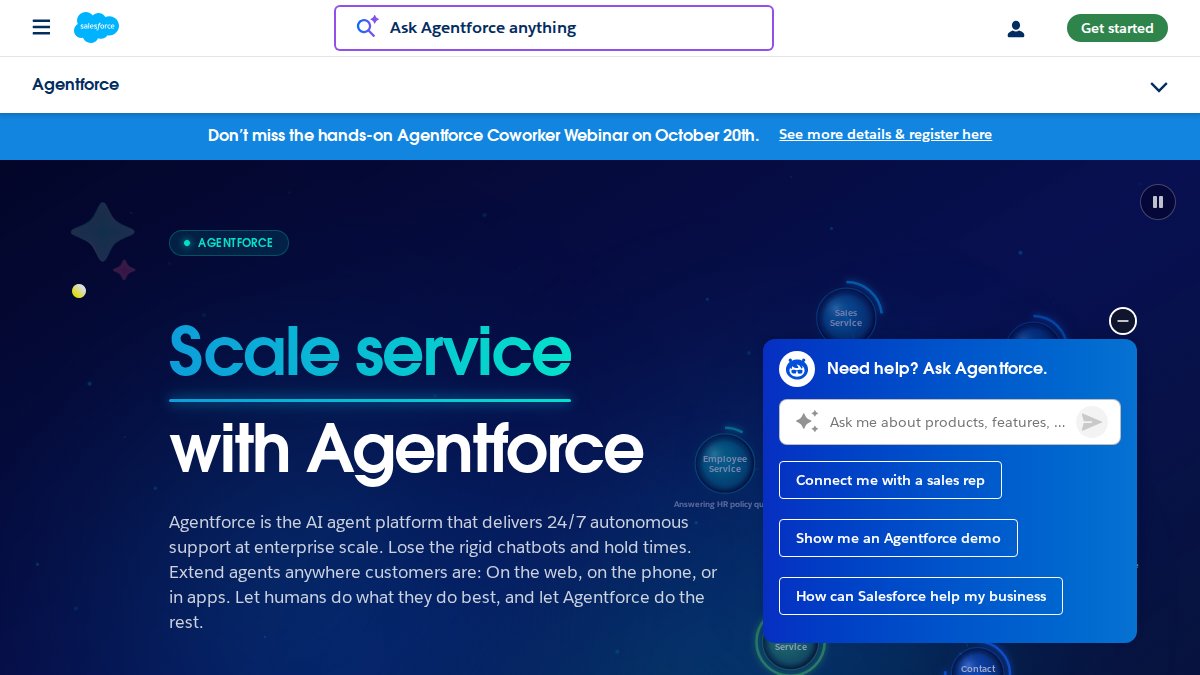
Salesforce Agentforce and PolyAI both appear in Gartner's list of Crescendo.ai alternatives, positioning them as enterprise-grade options. These platforms target large organizations with complex support requirements and existing Salesforce deployments.
Salesforce Agentforce integrates directly with Salesforce's CRM and Service Cloud, making it the natural choice if clients are already invested in the Salesforce ecosystem.
PolyAI takes a different approach, focusing on conversational AI that handles customer interactions across channels. The platform emphasizes natural language understanding and context awareness, which matters for complex customer service scenarios.
Both platforms require enterprise-level commitment and typically command higher pricing than mid-market alternatives. They're best suited for agencies serving large enterprise clients or managing high-volume support operations where the investment justifies the capabilities.
AI Customer Service Software for Multiple Brands: Multi-Client Capabilities
The defining requirement for agencies is managing AI customer service software for multiple brands without creating operational chaos. True multi-client capabilities mean more than just separate login accounts or basic filtering.
Look for genuine data isolation: one client's customer data should never be accessible to another client's support team or visible in analytics. Compliance and privacy regulations increasingly require this separation, and it's essential for client trust.
White-labeling is non-negotiable. Clients should see their own branding in customer-facing interfaces, dashboards, and communications. A generic platform interface undermines your agency's positioning and confuses your clients' end customers.
Separate billing per client simplifies your accounting and client relationships. You should be able to show each client exactly what they're paying for, without complex allocation formulas or bundled charges.
Crescendo.ai Pricing and Cost Comparison
Crescendo.ai's pricing centers on outcome-based billing similar to Intercom Fin: you pay when the AI resolves interactions without human intervention.
Outcome-based billing creates predictability challenges for agencies managing multiple clients. If a client's support volume doubles, your costs double without proportionally increasing internal support capacity, squeezing margins if contracts were priced on historical volume.
Compare this to per-agent models like Zendesk, where costs are fixed based on team size. Predictability is higher, but you're paying for capacity whether it's fully used or not.
Intercom Fin's $0.99-per-resolved-outcome pricing sits in the middle ground. It's outcome-based like Crescendo.ai but with transparent, published pricing that makes comparison shopping straightforward.
For most agencies, pricing alone shouldn't drive platform selection.
Agency-Specific Workflows: White-Labeling and Integration Requirements

White-labeling isn't a nice-to-have for agencies, it's essential infrastructure. Clients expect to see their brand, not your platform vendor's, across customer-facing interfaces, agent dashboards, reports, and communications.
Many platforms offer basic white-labeling (custom logo, color scheme) but miss the details that matter. Can you customize email templates with client branding?
Integration requirements determine implementation timeline and ongoing support burden. Evaluate whether the platform connects to clients' existing CRM, ticketing system, knowledge base, and communication channels.
Integration also affects how you position the platform.
How to Switch From Crescendo.ai to an Alternative
Switching platforms requires careful planning to avoid disrupting clients' support operations. The transition typically involves data migration, configuration, team training, and parallel testing before going live.
Start by auditing what data to migrate: conversation history, ticket data, customer profiles, and configuration settings. Some platforms make this straightforward; others require manual export-import processes that consume significant time.
Establish a parallel testing period where you run both platforms simultaneously on a subset of support traffic.
Communication with clients is critical during transition. Set clear expectations about timing, temporary disruptions, and how the new platform benefits them.
Migration typically spans 2-4 weeks from decision to full production deployment. Budget internal resources accordingly: migration requires your technical team's attention, not just the vendor's implementation team.
Frequently Asked Questions
What are the best Crescendo.ai alternatives for agencies managing multiple client accounts?
The best alternatives depend on whether you need software-only AI support or a bundled service. Intercom Fin charges $0.99 per AI-resolved outcome, making it cost-effective for high-volume support. Zendesk offers per-agent pricing at $55/agent/month annually for Suite Team, which scales well across multiple client teams. Software-only platforms like Twig, Sierra AI, Decagon, and Maven AGI let you avoid BPO bundles entirely. For enterprises, Salesforce Agentforce and PolyAI provide deeper integrations with existing systems. Evaluate each based on multi-client capabilities, white-labeling options, and how well they handle separate brand voices.
How does AI customer service software for multiple brands differ from single-client platforms?
Multi-brand platforms must isolate customer data, maintain separate knowledge bases, and allow independent configuration for each client's policies and tone. They should support white-labeling so each client sees their own branding, not yours. Integration with your agency's CRM and ticketing system is critical to avoid manual data transfers between clients. Look for platforms that let you set client-specific AI guardrails, response templates, and escalation rules. Most enterprise alternatives like Zendesk and Salesforce Agentforce handle this; software-only options vary in their multi-tenant capabilities.
What should I know about Crescendo.ai pricing compared to alternatives?
Crescendo.ai uses resolution-based pricing, meaning you pay when the AI resolves a customer issue. Intercom Fin charges $0.99 per end-to-end AI resolution. Zendesk's per-agent model ($55/agent/month annually) works better if you have dedicated support staff. Talkdesk, Sierra AI, Decagon, Maven AGI, Salesforce Agentforce, and PolyAI require contacting sales for pricing. The best model for your agency depends on your resolution volume, team size, and whether you want predictable monthly costs or outcome-based billing. Request quotes from multiple vendors to compare total cost of ownership across your client base.
Can I white-label an AI customer service platform for my agency clients?
White-labeling availability varies significantly. Enterprise platforms like Salesforce Agentforce and Zendesk typically offer white-labeling, but you need to confirm it's included in your plan. Software-only alternatives like Twig, Sierra AI, Decagon, and Maven AGI may have limited or no white-labeling built in. Intercom Fin and Talkdesk's white-labeling options depend on your contract level. Before committing to any platform, ask the vendor explicitly whether white-labeling is available, what it costs, and whether you can customize branding, domain, and response templates for each client.
How do I migrate from Crescendo.ai to another platform without losing customer data?
Start by exporting your conversation history, customer profiles, and knowledge base from Crescendo.ai in standard formats (CSV, JSON, or API exports). Map your existing workflows and AI rules to the new platform's equivalent features. Test the new platform with a small client first to ensure integrations work with your CRM and phone system. Plan the cutover during low-volume periods to minimize disruption. Most platforms offer migration support, but confirm this upfront and budget 2-4 weeks for the transition. Communicate the change to your clients in advance and monitor the first week closely for any issues with message routing or escalations.